
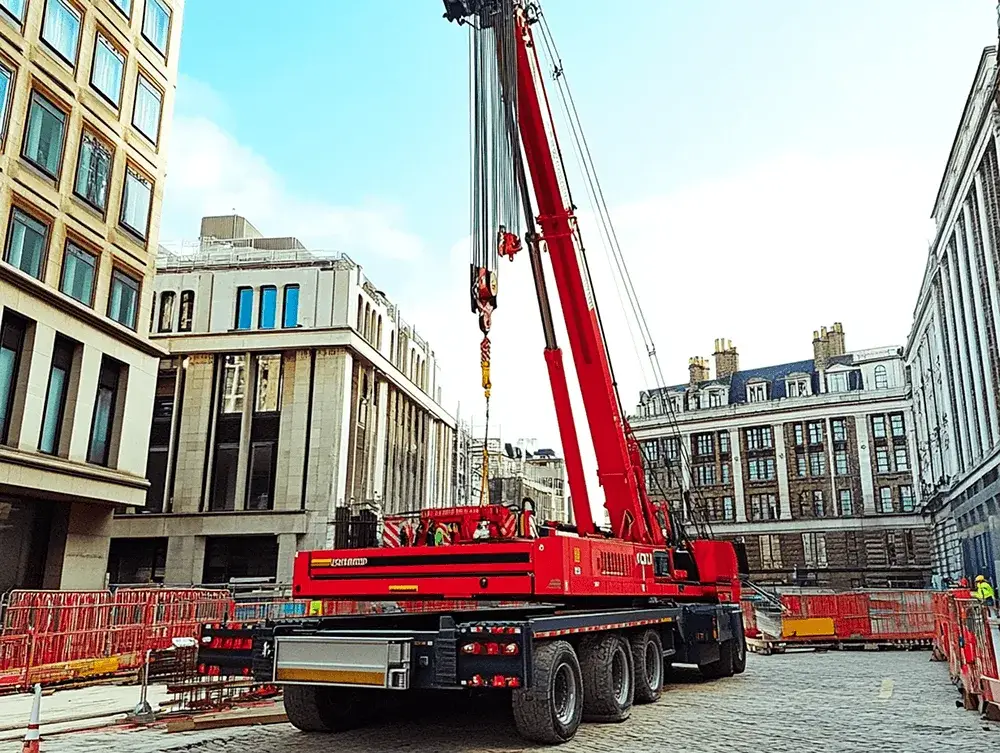
Why crane ground protection is different
A 40-tonne articulated lorry spreads its weight across five axles, typically twelve tyres. That works out to roughly 3 to 4 tonnes per wheel on firm ground. A mobile crane doesn't work like that. When the outriggers deploy, the entire load, the crane's own weight plus the suspended weight, concentrates into four small pads, each about 0.5 square metres. A 100-tonne crane lifting near capacity can punch over 40 tonnes through a single outrigger. That's not a distributed wheel load. That's a hydraulic press pushing straight down into the ground.
The difference matters because ground fails differently under point loading. A lorry rutting into soft ground is inconvenient. A crane outrigger punching through the crust into saturated subsoil is a reportable incident. The crane goes over. People get hurt. The job stops for weeks.
This is why every competent lift plan includes a ground bearing pressure calculation, and why ground protection mats aren't optional for crane work on anything softer than reinforced concrete.
Outrigger loads versus axle loads: the numbers
A standard two-axle rigid lorry at 18 tonnes gross applies roughly 4.5 tonnes per tyre across eight tyres. The contact patch of each tyre is about 0.05 square metres, giving a ground pressure of approximately 900 kPa. High, but brief and rolling.
A 100-tonne mobile crane with the boom at 60 degrees and a 9-tonne suspended load transfers about 85 tonnes total load to the outriggers, worst case. Divide that across four outriggers with pads at 0.5 square metres each, and the ground pressure under the most heavily loaded outrigger can exceed 1,600 kPa, nearly double the lorry's peak. And unlike a rolling tyre, the crane sits there. If the ground creeps, the outrigger sinks slowly and continuously until the load shifts. At that point the crane's centre of gravity moves, and you're into a tipping scenario.
This is why crane operators talk about ground bearing pressure, not axle load. It's the sustained point load that kills you.
What happens without proper mats
Soft ground under an outrigger pad does not fail all at once. It starts with settlement. The pad sinks a few millimetres, which tilts the crane chassis. Modern cranes have load moment indicators that will alarm and cut out if the tilt exceeds a threshold, usually 3 to 5 degrees. If the ground is firm enough to hold but soft enough to creep, you might get the lift done slowly and carefully. More often, the pad punches through.
When the ground fails, the outrigger drops suddenly by 100 millimetres or more. The load swings. The boom whip can be violent. If the crane was near its capacity chart limit, the momentary overload on the opposite outrigger can collapse it too. Two outriggers gone, crane on its side, load through whatever was underneath.
Even if it doesn't tip, a punched outrigger means a recovery operation. You'll need another crane, probably bigger, to right the fallen one. The ground damage alone can cost tens of thousands in remediation, never mind the crane repair and project delay.
How ground protection mats solve the problem
A crane outrigger pad on its own spreads load across about 0.5 square metres. Place that pad on a heavy-duty ground protection mat, and the load spreads across the mat's entire footprint. A standard PowerTrax 60 panel is 3 metres by 1.88 metres, roughly 5.6 square metres. The ground bearing pressure drops from over 1,600 kPa to under 300 kPa. That's the difference between a crane sitting safely and a crane sinking into the turf.
The physics works because the mat is stiff in bending. Load applied at the centre travels through the panel's structural ribs to the edges, where the interlocking joints pass it to adjacent panels. A proper crane pad isn't a single mat under each outrigger. It's a linked platform of four or more panels per outrigger, sometimes a continuous pad linking all four outriggers together. The bigger the platform, the lower the ground pressure.
Lift plan requirements and ground bearing pressure
Every lift plan produced under BS 7121, the British Standard for safe crane operation, must assess ground conditions and specify ground bearing capacity. The appointed person calculates the maximum outrigger load for the planned lift, divides by the outrigger float area, and compares that to the known or estimated ground bearing capacity of the surface.
If the calculated pressure exceeds the ground capacity, the lift plan must specify additional load spreading. This is where trackway mats enter the formal documentation. The mat manufacturer's load-spreading data gets factored into the calculation. For PowerTrax 60, the rated capacity is 150 tonnes when laid as a continuous roadway on firm ground. That rating gives the appointed person a defensible number to put in the lift plan.
No lift supervisor should accept a crane setting up on soft ground without a written assessment and the specified mats in place. If the mat type or configuration isn't what the lift plan calls for, the lift doesn't happen.
Which mat for which crane
Not every crane needs the heaviest mat. A 25-tonne city crane on reasonably firm ground can sit safely on TuffTrak panels, which are lighter, easier to handle, and cost less to hire. TuffTrak handles vehicles up to 35 tonnes gross on firm ground. For a compact crane doing a straightforward lift at low radius on a stable surface, that's often sufficient.
The line gets drawn around 50 tonnes crane capacity, or any lift where the outrigger load calculation exceeds 15 tonnes per pad. At that point, you move to PowerTrax 60. It's the only track mat in the GT Trax range rated for the sustained point loads that heavy mobile cranes generate. PowerTrax 40 sits in between, rated for 100 tonnes, and works for mid-range crawler cranes and piling rigs where the load is more distributed than a single-point outrigger.
The right mat isn't about the crane's nominal capacity. It's about the worst-case outrigger load on the day, factoring in ground conditions, boom angle, radius, and wind. An experienced ground protection supplier can work through those numbers with the crane crew before the mats arrive on site.
Getting the specification right
Crane pad ground protection is not a commodity hire item. The difference between the right mat and the wrong one is a safe lift versus a crane on its side. The three things to get right:
-
Calculate the outrigger load. Not the crane's SWL, not an estimate. Get the number from the lift plan or the appointed person.
-
Assess the ground. Firm grass over clay is not firm ground. It's a crust. If there's been rain, if there's any doubt about subsoil conditions, assume the worst and spec up.
-
Match the mat to the load. TuffTrak for light cranes on good ground. PowerTrax 60 for anything heavy, marginal, or safety-critical. If you're unsure, the heavier mat is always the cheaper option compared to a crane recovery.
GT Trax supplies crane mats and ground protection across the UK, from single-day mobile crane lifts to months-long tower crane compounds on construction sites. Outrigger mats hire includes delivery on flatbed lorries with mechanical handling kit, and installation crews lay the platform to the specification in the lift plan.
Products mentioned in this article
- PowerTrax 60: HDPE composite heavy-duty track mats rated for 150 tonnes and sustained crane outrigger point loads
- TuffTrak: versatile 150-tonne mats with Chevron grip surface, suitable for compact cranes on firm ground
- PowerTrax 40: large-format rubber mats rated for 100 tonnes, ideal for crawler cranes and piling rigs
You may also be interested in
- What Load Rating Do I Need for My Site Traffic?: understand what your vehicles weigh and which track mats can handle them, from transit vans to 150-tonne HGVs.
- Ground Protection for Utility Works: Keeping Sites Safe and Accessible: how temporary trackway, walkway, and cable protection keep utility and construction projects moving on soft ground.
Contact our team to run through your crane pad requirements. We'll help you spec the right mat configuration and get it on site when you need it.