
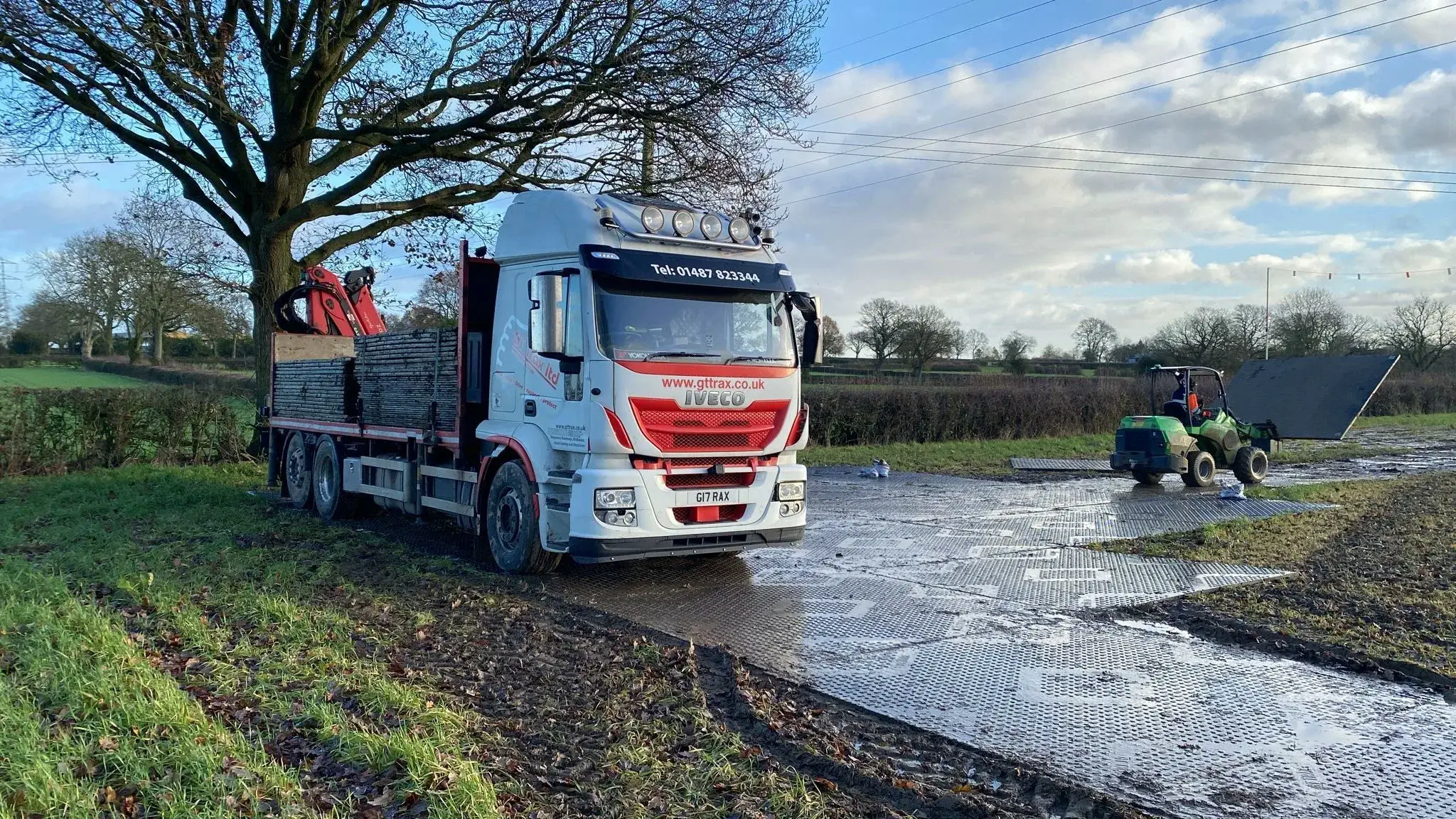
Why saturated ground fails so fast
British winters rarely arrive as a hard freeze. They arrive as rain, week after week, on ground that never gets the chance to dry out. By December the soil in the top metre is holding far more water than it can drain away.
Once soil is saturated, every further millimetre of rain either runs across the surface or sits in it. Water fills the pore spaces between particles, the pressure inside those pores rises, and the friction that holds the soil together drops. That friction is what gives ground its strength. Take it away and the bearing capacity falls with it.
Different soils fail at different speeds. Sand and gravel drain, so they recover between storms. Clay does not. It holds the water, softens, and turns to slurry under traffic, then stays soft for the rest of the winter because there is nothing to drain into.
The result is the pattern every site manager recognises. Ruts along the access route. Muck dragged onto the public highway. Wheelspin where vehicles leave hard standing. Plant that needs recovering instead of loading. Every one of those costs programme days, and the wet months are when programme days are scarcest.
What fails in wet weather
Lightweight pedestrian panels are the first thing to go. LiteTrax GridMat is rated to 300kg, and that is exactly what it is for: foot traffic, wheelchairs, buggies. Put it under a loaded HGV on soft ground and it either punches through or rides up as the wheels spin.
The problem is not only weight. It is contact area and stiffness. A thin panel laid on soft ground bends, loses contact with the surface beneath, and concentrates the load on a small patch of soil. Once that patch fails the panel tilts, the next panel takes the hit, and you spend the winter relaying the same section.
Weight matters as well. A light panel sitting in standing water shifts under traffic, and every shift opens a gap for more water and muck to travel through. Heavy panels stay where they are put.
So the winter specification comes down to three things. Enough spread to bring ground pressure down to something saturated soil can carry. Enough stiffness not to bend into the soft spots. Enough weight to stay put once it is down. Thickness buys you the stiffness, and panel size buys you the spread.
Which trackway works on waterlogged ground
PowerTrax 60 is the panel we specify most often on saturated sites. It is a 60mm HDPE composite panel rated to 150 tonnes, and each one is 3m by 1.88m, giving 5.6 square metres of cover per panel. The composite does not absorb water, so it stays dimensionally stable through weeks of standing puddles, and a market-leading interlock keeps the roadway continuous as the ground beneath it moves. At 225kg a panel it is lifted and placed with plant, not by hand.
PowerTrax 40 is the rubber alternative, also rated to 150 tonnes, in a 40mm panel measuring 2.4m by 3m. Rubber conforms slightly to uneven ground instead of sitting on the high points, which makes it forgiving on a route that is already rutted, and it grips well when wet. It is the usual choice for general construction access and site car parks, and the quieter option where noise matters.
TuffTrak is rated to 150 tonnes at 3m by 2.5m and 38mm thick. Its chevron tread channels water and mud away from the contact surface, which is the reason to choose it on wet clay where the surface grip is as much of a problem as the bearing capacity underneath.
PowerTrax 20 is rated to 38 tonnes at 3m by 1m and 20mm thick, with ground-securing pins that lock the panels together. It suits light plant, vans, telehandlers and mixed pedestrian traffic. On saturated clay under heavy plant it is not the answer, however convenient the panel size is.
For the people on site rather than the vehicles, WalkOvers are 20mm recycled tyre panels with an anti-slip surface, 1.2m by 0.7m, rated to 0.75 tonnes. They keep pedestrians off the vehicle route, which matters more in winter than in summer, when the alternative is a mud track around the compound.
Plan the winter route before the ground turns
The cheapest panel is the one ordered in October, before the forecast turns and every site in the county is chasing the same stock.
Work the quantity out from the route rather than from a guess. A 3m wide access road running 100m is 300 square metres. Each PowerTrax 60 panel covers 5.64 square metres, so that route needs just over 50 panels on a straight run, before you add turning areas, passing places and the pad at the compound gate. Then identify the short sections that will fail first and protect those properly, because a route fails at its weakest point and the rest of the panels only hold if that point holds.
Keep a stack of spares on site for those sections. The alternative is a midwinter call for four more panels while a wagon waits at the gate.
The full range, with panel sizes and load ratings for each system, is on the trackway hire page.
Start before the first bad forecast
Ground protection is one of the few items on a construction budget that gets cheaper the earlier you deal with it. Panels ordered ahead of the winter are a planned hire cost. Panels ordered after the access road has failed are an emergency, and they arrive with recovery costs, standing time and a programme that has already slipped attached to them.
We hold stock for exactly this reason, and our crews lay trackway on live sites through the winter months. The winter conditions project shows a recent job where saturated ground was keeping plant off site until panels went down.
If the site is already wet and the programme is going, the access road is usually the first thing to fix. We set out the failure points and the sequence to protect them in keeping a construction site moving in wet weather.
Frequently asked questions
Why does ground fail in winter?
Sustained rain fills the pore spaces in the soil, which raises the water pressure inside them and reduces the friction between particles. That friction is what gives ground its strength, so bearing capacity falls as saturation rises. Clay holds the water for weeks, which is why a route that carried loaded wagons in summer can stop carrying anything by January.
Which track mats are best for waterlogged ground?
PowerTrax 60 is the panel we specify most often on saturated construction sites. It is a 60mm HDPE composite panel rated to 150 tonnes, and it spreads load across 5.6 square metres, so the ground beneath it carries far less pressure than it would under a wheel. PowerTrax 40 and TuffTrak are also rated to 150 tonnes and suit general access roads where grip and a slightly larger panel matter more than maximum stiffness.
Can trackway be laid on soft ground without preparing it first?
Yes. Trackway is laid on top of the ground rather than dug into it, which is exactly why it works on soft ground: vehicles stay off the soil and the load is spread across the panel. Strip standing water and obvious ruts where you can, because a level base makes the panels sit better and interlock more cleanly, but the system is designed to be laid on ground that is already deteriorating.
How many panels do I need for a winter access road?
Work out the area first. A 3m wide access road running 100m is 300 square metres, and each PowerTrax 60 panel covers 5.64 square metres, so that route needs just over 50 panels before you add turning areas, passing places and the pad at the compound gate. Send us the route dimensions and we will work the quantity through with you.
Products mentioned in this article
- PowerTrax 60: 60mm HDPE composite trackway rated to 150 tonnes for saturated ground and heavy plant
- PowerTrax 40: 40mm rubber trackway panels for general site access, car parks and wet conditions
- TuffTrak: chevron-tread composite mats for soft ground where surface grip matters
- PowerTrax 20: 38-tonne panels for light plant and mixed pedestrian traffic
- WalkOvers: recycled tyre pedestrian walkway panels with an anti-slip surface
- LiteTrax GridMat: snap-together grid panels that drain standing water around compounds
You may also be interested in
- Keeping a Construction Site Moving in Wet Weather: where access roads fail and how to protect the sections that matter.
- What Load Rating Do I Need for My Site Traffic?: work out what your vehicles weigh before you choose a panel.
- Track Mats vs Track Tiles: the difference between a mat that carries plant and a tile that carries people.
Contact our team to talk through winter ground protection for your site. Tell us the route and the vehicles and we will work out the panels you need.